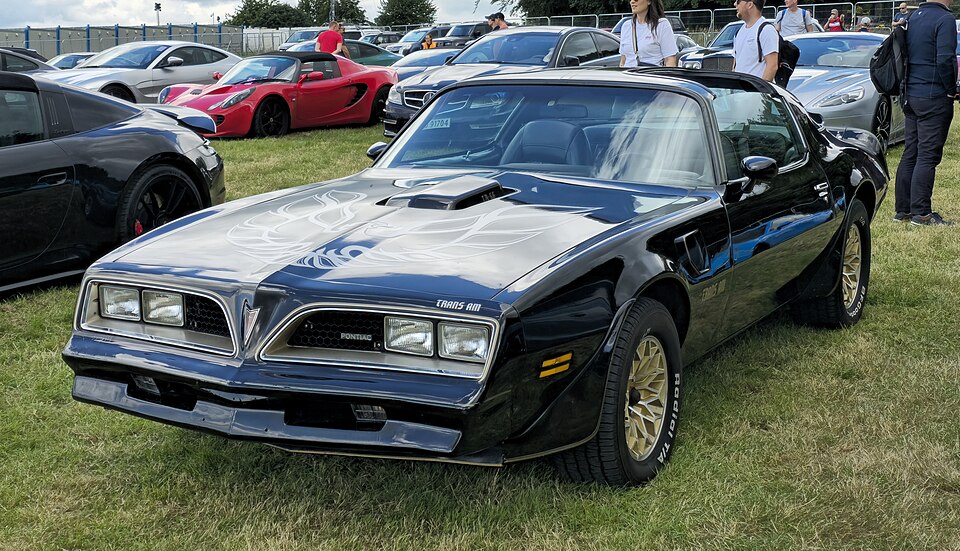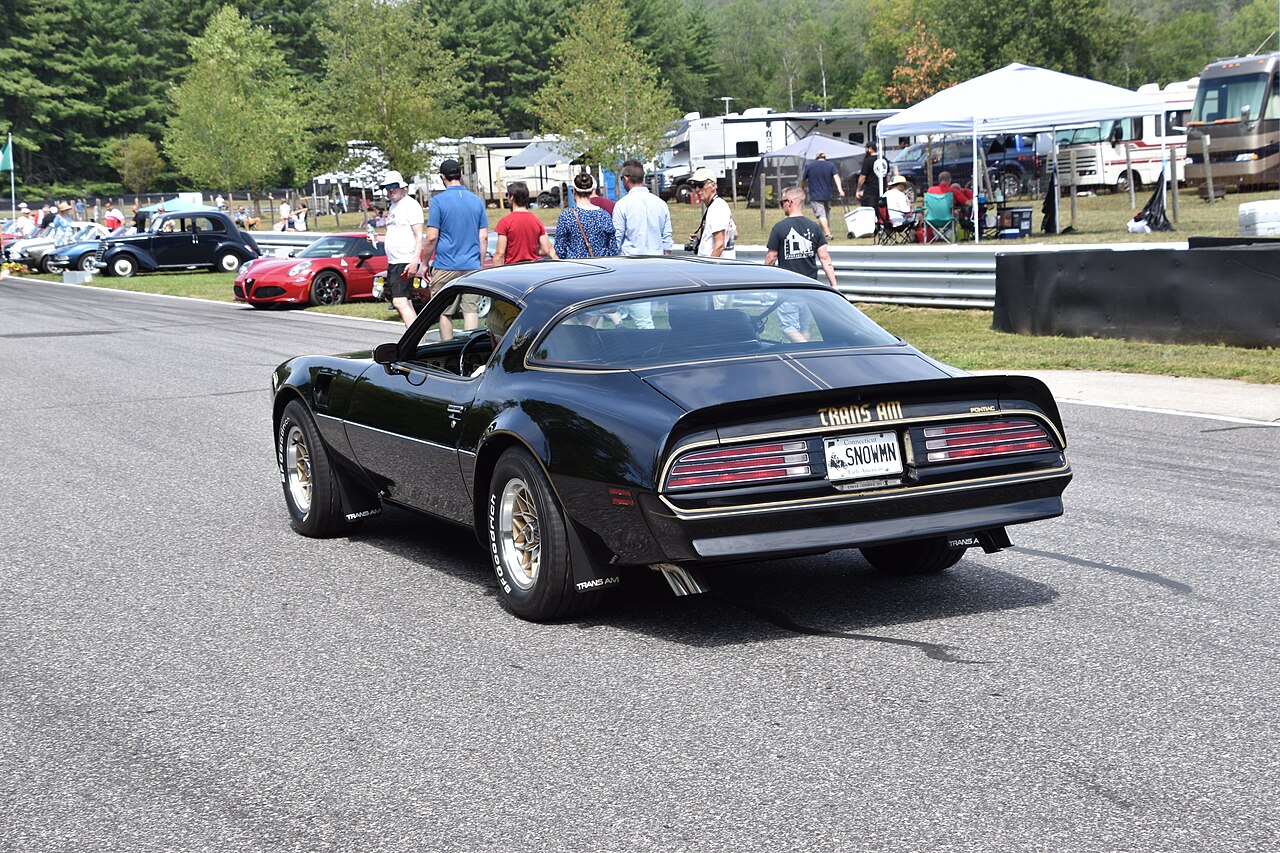
If you have ever asked what Trans Am did Burt Reynolds drive, you already know the image: Starlight Black paint, gold stripes, a Firebird decal stretched across the entire hood, and a shaker scoop pointing skyward. The short answer is a specially built 1977 Pontiac Trans Am. The complete answer takes a bit more unpacking, and the details matter if you are serious about understanding what those film cars actually were.
The 1977 Pontiac Trans Am: What Was Actually on Screen
By 1977, the second-generation Firebird platform had been in production for seven years. Pontiac had refined the Trans Am into a visually aggressive package with genuine performance credentials, even as emissions regulations were strangling output across the industry. The 1977 Trans Am offered the 400 cubic inch V8 in standard form and in the W72 performance tune, which Pontiac marketed as the T/A 6.6. A 403 cubic inch Oldsmobile V8 was also available in certain configurations that year. The large Firebird hood decal, the functional shaker scoop, and the available black-and-gold color combination made the 1977 model a natural fit for what director Hal Needham had in mind.
Pontiac provided support for the Smokey and the Bandit production, and the cars used on screen were specially prepared vehicles, not units pulled from dealer inventory. Several Trans Ams were built for the film, and they were not all identical. Stunt cars were reinforced to survive repeated high-speed work and the physical punishment that comes with a production schedule. Hero cars, the ones used for close-up shots and interior scenes, were kept in cleaner cosmetic condition. The specific combination that defined the look was Starlight Black paint, gold body striping, the screaming chicken hood decal, and the shaker scoop.
Calling any standard black-and-gold 1977 Trans Am a "Bandit car" is not accurate. The film cars were purpose-built for that production. A genuine filming vehicle carries documented provenance. A regular 1977 Trans Am in the same color combination is a great second-gen, but the two are not the same thing.
The seats in the film cars were vinyl, consistent with every other second-generation Trans Am. Factory Trans Am interiors during this era were not leather.
The Y84 Special Edition: Pontiac's Production Answer to the Film
Smokey and the Bandit opened in May 1977 and finished as one of the highest-grossing domestic films of that year. Pontiac took note. Beginning with the 1978 model year, the division offered the Y84 Special Edition package, which gave production buyers a factory-built version of the black-and-gold look Reynolds had put in front of millions of moviegoers.
The Y84 brought Starlight Black paint, bold gold Firebird decal, gold striping, and a specific interior combination. The bucket seats in these cars were the Deluxe Bucket design that became standard Trans Am equipment starting with 1978. Like every other second-gen Trans Am interior, the upholstery was vinyl. Anyone restoring a Y84 to factory specification needs to be clear on that point: the factory did not put leather in these cars.
The Y84 remained in the Pontiac order guide through the 1981 model year, giving buyers four years to purchase a production version of the Bandit look. Healthy production numbers across those model years mean that Y84 cars are not exceptionally rare compared to some other Trans Am packages from the same era.
For contrast, the 1979 10th Anniversary Trans Am (RPO Y89) came finished in Platinum Silver Metallic with silver leather-trimmed bucket seats. That makes the Y89 the only second-generation Trans Am that ever left the factory with leather seating. It has nothing to do with the Bandit package visually or conceptually, but knowing it exists helps when you are sorting out a car's identity.
Smokey and the Bandit II and Reynolds Behind the Wheel Again
Smokey and the Bandit II hit theaters in August 1980, and Reynolds returned in a Trans Am. The second-generation car was in its final stretch by 1980, and the production vehicles in the sequel reflected that era's specifications. Once again, multiple cars were built for the film and they were not all configured identically.
The 1980 Trans Am engine lineup included the 400 cubic inch W72 as the performance option, the 403 cubic inch Oldsmobile V8 as the standard choice, and the 301 cubic inch Pontiac V8 as a low-cost credit option that was uncommon in practice. California buyers received the 403 because the 400 was not California-certified during that period. The 301 was not a California-specific engine.
Reynolds was a genuine Trans Am enthusiast and his connection to the car extended beyond paid promotion. He publicly associated himself with the brand throughout the late 1970s and early 1980s, which added a layer of credibility to the on-screen partnership with Pontiac that advertising alone could not have manufactured.
What Set the Film Cars Apart from Standard Production
The distinction between a film car and a production Trans Am is worth understanding at the mechanical level, not just the cosmetic one. Stunt vehicles built for a production like Smokey and the Bandit typically receive suspension modifications, additional structural reinforcement, and other changes that make them safer and more durable for repeated high-stress use. They are built to a different specification than a dealer car, even when they look identical on the outside.
This is why provenance documentation is so important when a black-and-gold 1977 Trans Am is offered as a genuine filming vehicle. The actual production cars have a paper trail. Without it, you have a very good-looking 1977 Trans Am, which is worth having on its own merits, but it is not what it is claimed to be.
For anyone doing serious restoration or research on Bandit-era cars, original Pontiac factory service literature remains the most reliable reference for what came on a given car from the factory.